Artificial intelligence is the art of getting computers to do things that look like they need a brain: recognising faces, translating languages, writing an email you did not want to write. The computer scientist Larry Tesler once observed, roughly, that AI is “whatever hasn’t been done yet”. The moment a machine can do something, we start calling it “just software”. Spell-check was AI once.
So what is AI, actually?
AI is a big umbrella. Under it sits machine learning, where computers learn from examples instead of following hand-written rules. Under that sits deep learning, which uses large neural networks. And the newest, loudest member of the family is generative AI: models that produce text, images, music and code.
Everything you can use today is narrow AI: very good at specific things, oddly bad at others. The same kind of system that can summarise a 300-page report has, famously, struggled to count how many r’s are in “strawberry”. The robot from the movies that can do everything a human can is called artificial general intelligence, and it is still a research goal, not a product.
Rules versus learning
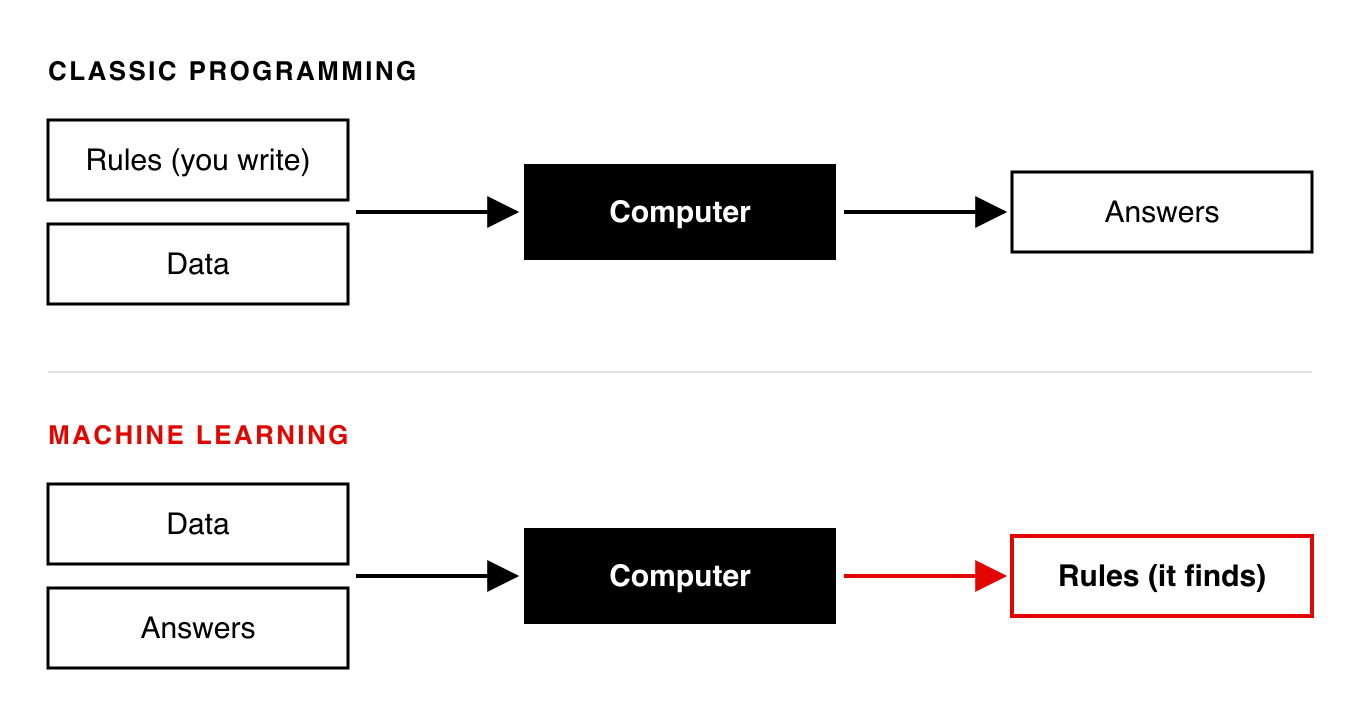
Try writing rules for spotting a cat: four legs, whiskers, pointy ears, fur. Now explain why a fox is not a cat, why a cat in a box with no legs visible still is, and what to do about the hairless ones. You will be writing rules until you retire.
Machine learning flips the job around. Instead of writing the rules, you show the computer a million photos labelled “cat” and “not cat”, and it works out the rules itself. Nobody fully understands the rules it ends up with, including the computer, but they work remarkably well.

How a neural network works
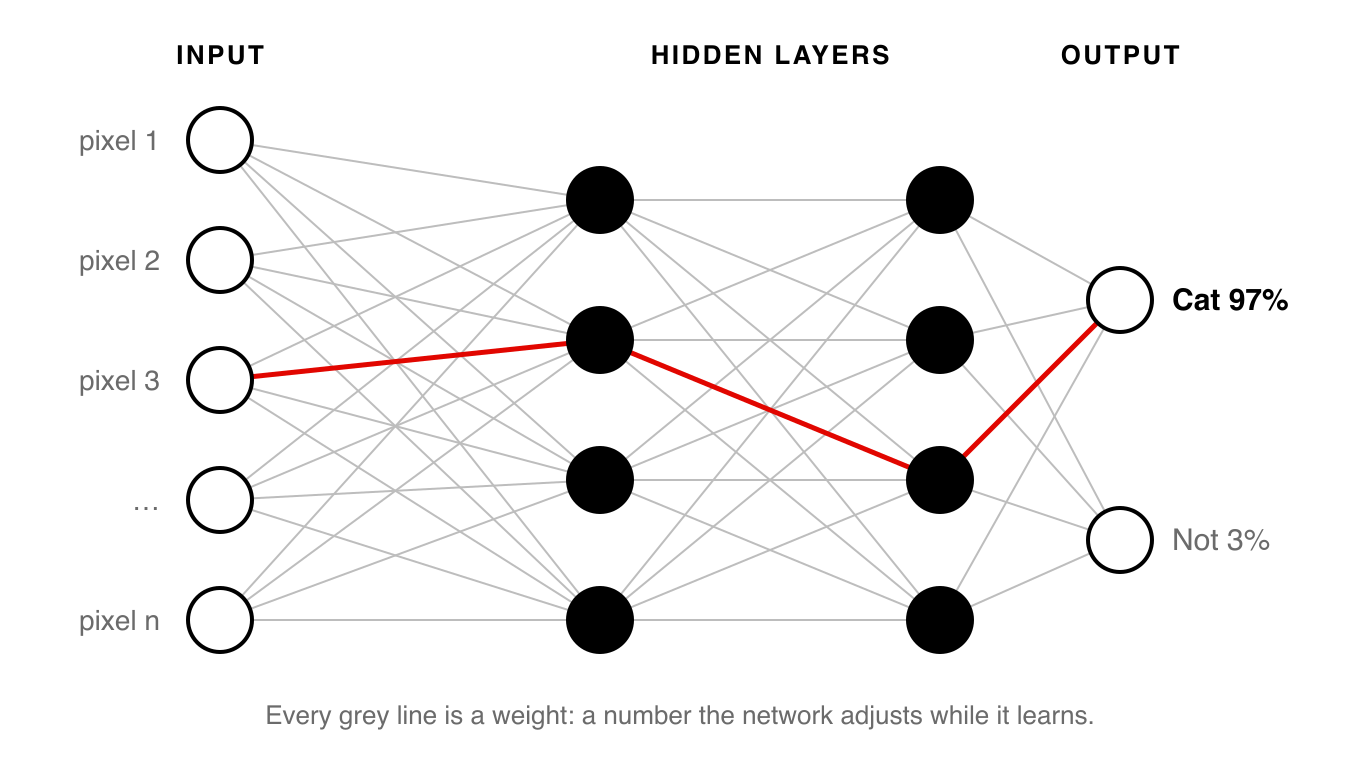
A neural network is a stack of very simple calculators called neurons. Each one takes in some numbers, multiplies each by a weight (how much it cares about that input), adds them up and passes the result on. For a photo, the first layer receives raw pixel values; the last layer outputs answers like “cat: 97%”.
The layers in between are where the magic happens: early ones learn to spot edges, later ones combine edges into ears, whiskers and suspicious expressions. Networks are loosely inspired by the brain, in roughly the way a paper aeroplane is inspired by a bird. And they are big: GPT-3, released in 2020, had 175 billion weights. Modern models have even more knobs than that.
How it learns: hot and cold, billions of times
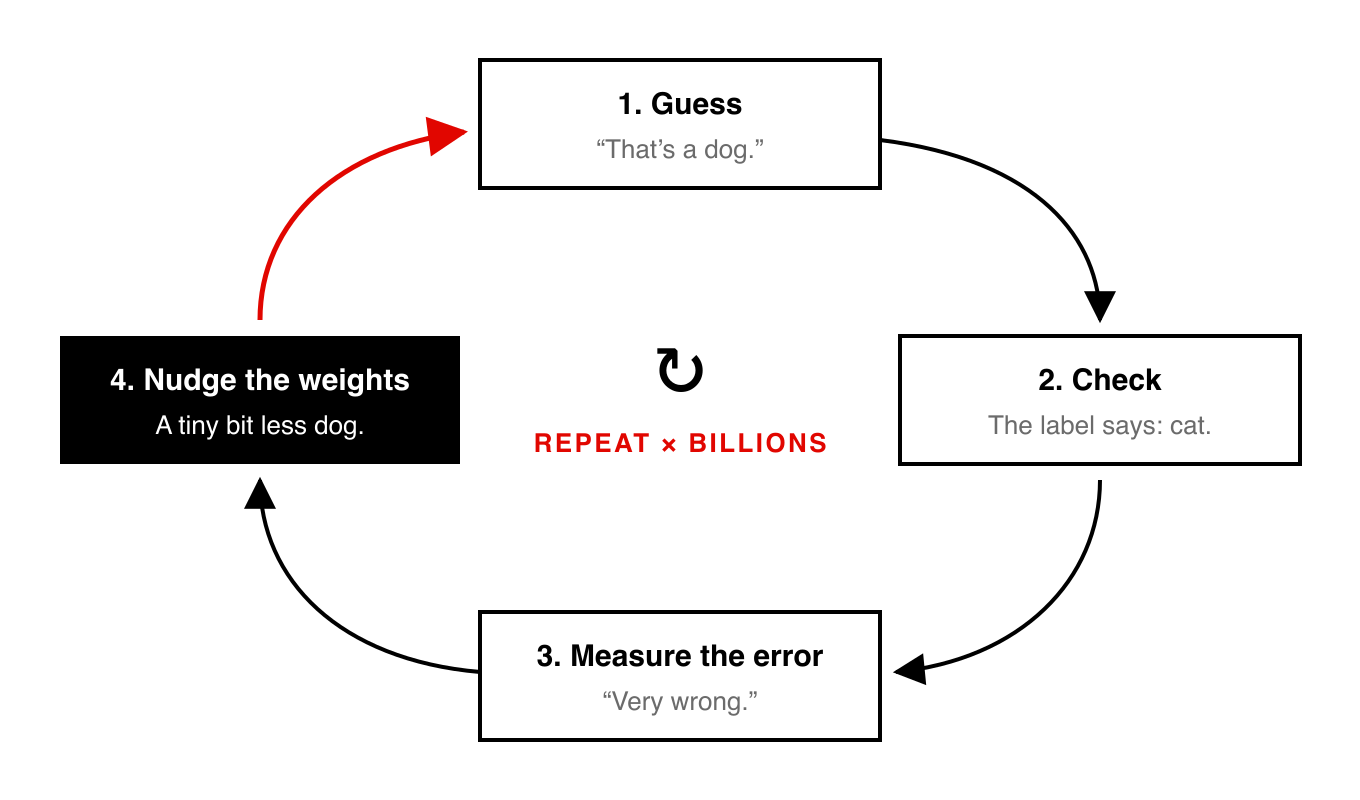
A brand-new network knows nothing; its weights are random, so its answers are random too. Training fixes that with a very patient loop. The model makes a guess, compares it with the right answer, measures how wrong it was, and nudges every weight a tiny bit in the direction that would have made it less wrong. Then it does that again. And again. Billions of times.
The nudging has a name, gradient descent: imagine trying to reach the bottom of a valley in thick fog by always stepping slightly downhill. A trick called backpropagation works out how much each weight was to blame for the mistake, so each one gets just the right nudge. It is like learning darts blindfolded while a friend shouts “warmer” and “colder”, except the friend is maths and never gets bored.
Fun fact: Models learn exactly what the data teaches them, not what you meant. In a 2016 experiment, researchers deliberately trained a husky-versus-wolf classifier on photos where every wolf had snow in the background. It became an excellent snow detector. That is why people who build AI spend so much time worrying about their data.
How chatbots work
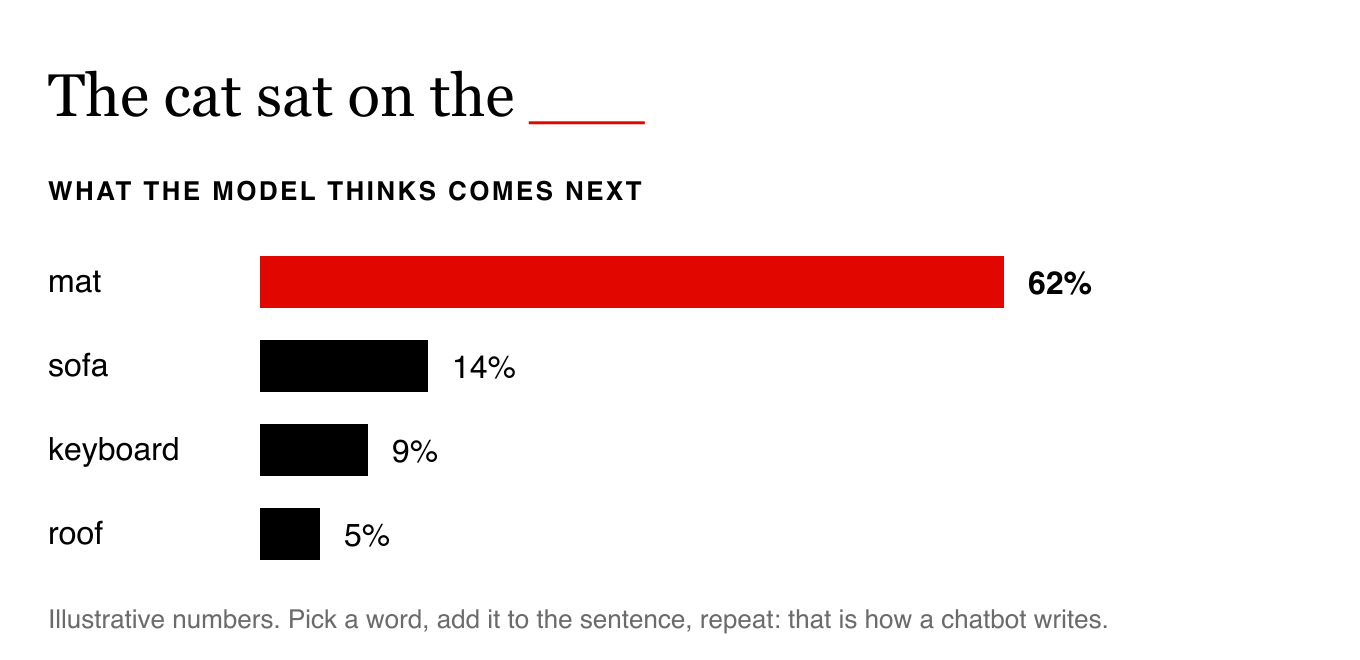
A large language model, the engine inside chatbots like ChatGPT, Gemini and Claude, is trained on a vast amount of text to do one deceptively simple thing: predict the next word. Strictly speaking it predicts the next token, a chunk of a word, which is part of why counting letters trips it up. Give it “The cat sat on the” and it rates every possible next token; pick one, add it to the sentence, and repeat. Do that very well, at enormous scale, and grammar, facts, jokes and even some reasoning fall out of it.
Raw next-word predictors are not great conversationalists, so they are then fine-tuned with human feedback: people rate answers, and the model learns to give the kind people prefer. The result is autocomplete that has read a good chunk of the internet and learned some manners.
Handle with care: Because it is predicting plausible text, a language model can produce plausible nonsense with total confidence. This is called a hallucination. In 2023, two New York lawyers were fined $5,000 after submitting a court brief citing cases that ChatGPT had invented. The cases sounded very convincing. They did not exist.
How AI is already changing everyday life
You probably used AI several times today before breakfast, mostly without noticing:
Your inbox: Gmail says its filters block more than 99.9% of spam, phishing and malware. Somewhere, a prince with an urgent inheritance is very frustrated.
Your phone: it unlocks when it sees your face, finds “dog” in your photos without you ever tagging one, and improves pictures as you take them.
Your commute: map apps predict traffic and reroute you around jams, and in a growing number of cities you can hail a car with nobody in the driver’s seat.

Your evenings: according to Netflix’s own researchers, about 80% of what members watch is found through recommendations. Your next favourite show was chosen by a model that noticed you finished three heist films in one weekend.
Your world: translation apps let you read menus in languages you cannot pronounce, and AI tools help doctors read scans and scientists design new materials.
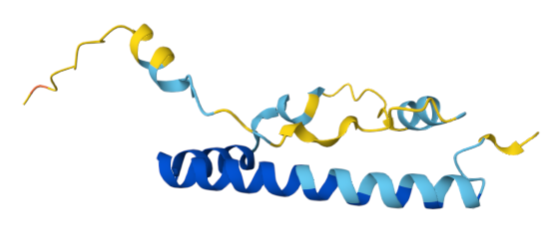
Science: AlphaFold, from Google DeepMind, predicts the 3D shape of proteins from their chemical recipe, a problem biologists had wrestled with for about 50 years. Its database now holds over 200 million predicted structures, and in 2024 two of its creators, Demis Hassabis and John Jumper, shared the Nobel Prize in Chemistry.
What AI is not (yet)
Today’s AI does not have feelings, wants or opinions, even when it sounds like it does. It does not “know” things the way you do; it has learned patterns. It can be confidently wrong, and it can repeat the biases in its training data. It is a tool, an extraordinarily useful one, and it works best with a human paying attention.
The best way to think about it: a brilliant intern who has read nearly everything, never sleeps, works in seconds, and will occasionally invent a court case with a completely straight face. Check its work.