 By Roman Aglaganov
Multiplying matrices, grids of numbers, is the most important boring thing computers do. Graphics, physics simulations and every AI model run on it. So when someone finds a faster way to do it, mathematicians pay attention.
Strassen’s trick
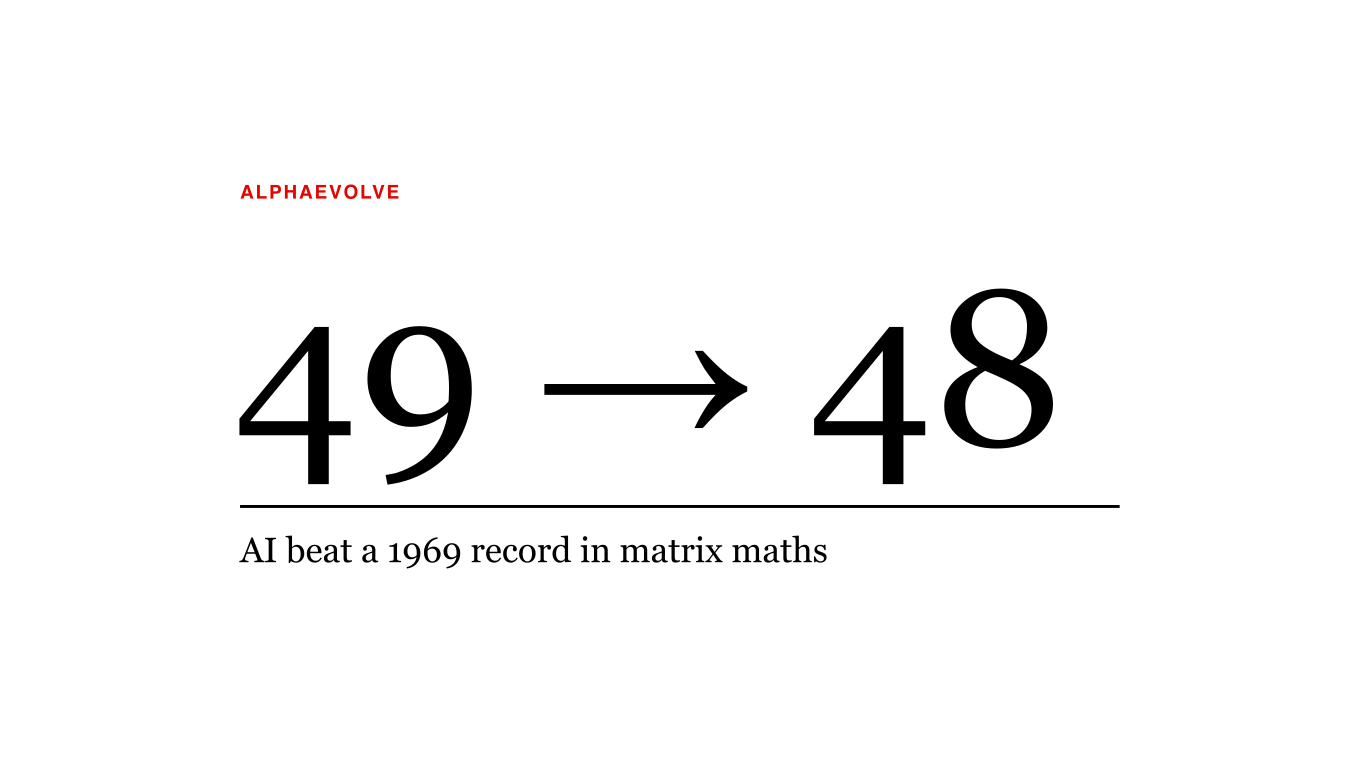
In 1969, the German mathematician Volker Strassen showed that the schoolbook method, which needs 64 multiplications to multiply two 4×4 matrices, was not the best possible. His clever rearrangement needed 49. For complex-valued matrices, the kind used in physics and signal processing, nobody beat that for 56 years.
Enter AlphaEvolve
In May 2025, Google DeepMind announced AlphaEvolve, a coding agent that combines its Gemini language models with an evolutionary process. Gemini proposes changes to a program; an automatic evaluator scores each version; the best survive and get mutated again, round after round. It is natural selection, with code instead of finches.
Among its results, AlphaEvolve found a way to multiply two 4×4 complex matrices with 48 multiplications. One fewer than Strassen. Repeated billions of times inside larger calculations, one multiplication adds up.
Not just matrices
DeepMind set AlphaEvolve loose on about 50 open maths problems. It matched the best known solutions in about 75% of cases and improved on them in about 20%, including progress on the kissing number problem, a 300-year-old puzzle about how many spheres can touch one sphere at the same time.
It also worked on Google’s own infrastructure: a scheduling rule it found for Google’s data centres has been in production for over a year and recovers, on average, 0.7% of Google’s worldwide computing resources. At Google’s scale, that is a lot of free computers.
Why it matters: language models are often accused of only remixing what they have seen. Paired with a strict automatic checker, they can find genuinely new things, and in maths a proof is a proof, whoever finds it.