By Roman Aglaganov
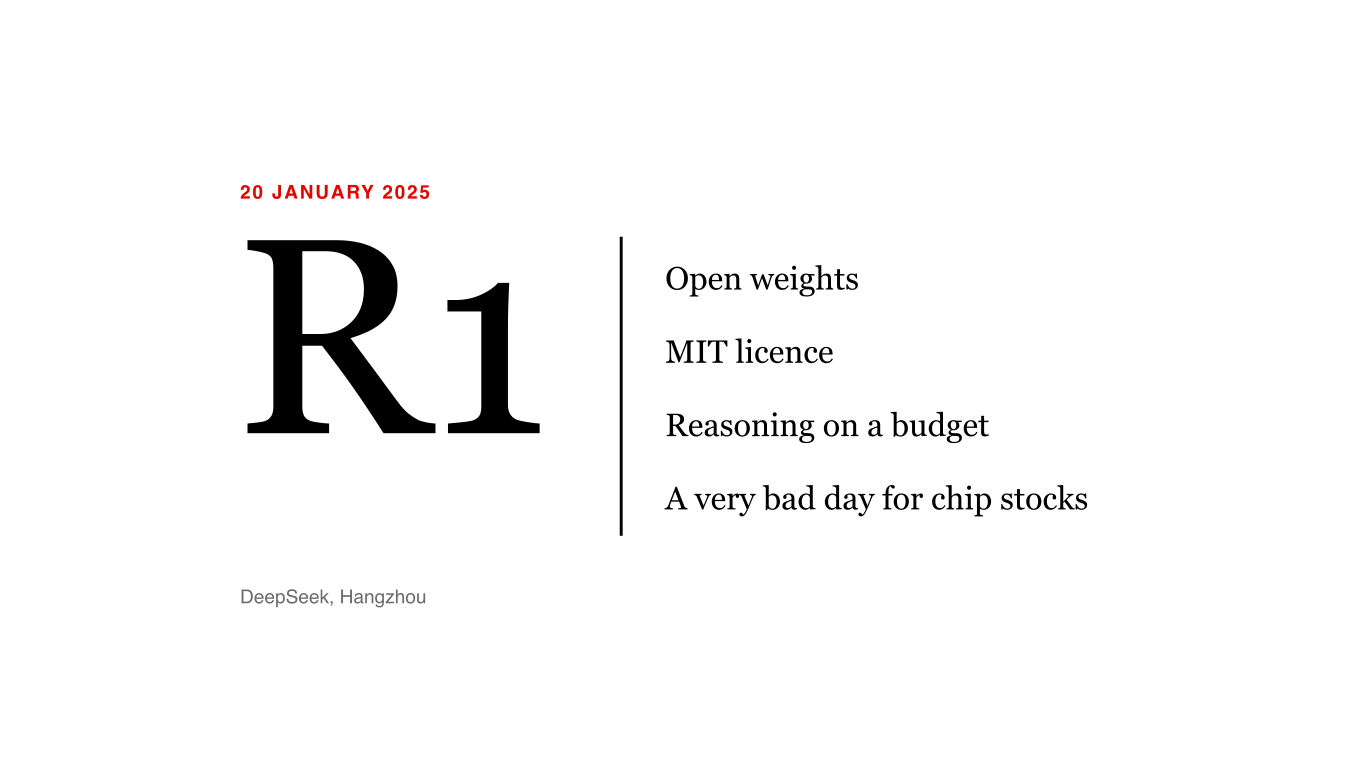
On 20 January 2025, DeepSeek, an AI start-up from Hangzhou backed by a quantitative hedge fund, released R1: a reasoning model that, according to its own paper, performed on par with OpenAI’s o1 on many maths, coding and reasoning tests. It also did something the American leaders had not: it released the model’s weights for anyone to download, under the permissive MIT licence.
The number everyone quoted
R1 was built on DeepSeek’s V3 model, whose technical report said the final training run took about 2.8 million hours on Nvidia H800 chips, roughly $5.6 million at rental prices. That figure leaves out the research, failed experiments and hardware behind it, a caveat the report itself makes. But next to the billions American labs were spending, it landed like a dropped tray in a quiet restaurant.
The DeepSeek app shot to the top of Apple’s App Store in the United States. On 27 January, investors wondered whether the world would need quite so many expensive chips after all, and Nvidia’s share price fell about 17%, erasing nearly $600 billion of market value, the largest one-day loss for any company in US stock-market history at the time.
Why it mattered technically
The R1 paper showed that strong reasoning could be taught largely through reinforcement learning: let the model attempt problems with checkable answers, reward it when it gets them right, repeat. An early version, R1-Zero, learned to reason this way with no human-written examples at all, and the authors described watching it learn to pause and re-check its work as an “aha moment”.
The aftermath
Chip stocks recovered, and demand for AI computing kept climbing: cheaper AI tends to mean more AI, not less. But R1 changed the conversation. It showed that open-weight models could reach the frontier, that clever engineering could stretch a limited supply of chips a long way, and that the AI race was not a one-country event.