By Roman Aglaganov
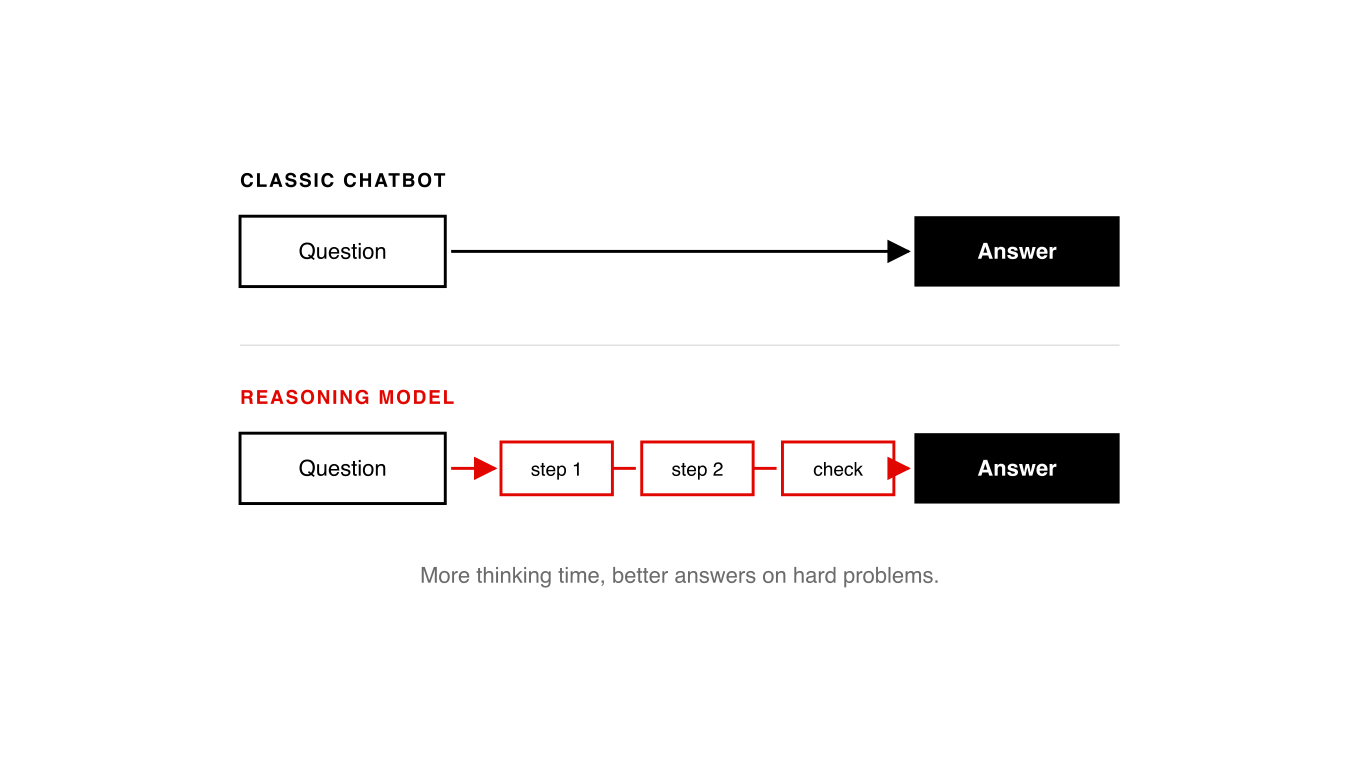
Ask an early chatbot a tricky maths question and it would answer instantly, confidently and often wrongly, like a student who skipped the working and went straight for the box at the bottom of the page. Today’s best models do something different: they think first.
Show your working
In 2022, Google researchers found that simply prompting a large model to reason step by step, which they called chain of thought, made it much better at maths word problems. Writing out intermediate steps gives the model room to work things out instead of guessing the answer in one go.
From a trick to a training method
In September 2024, OpenAI released o1, a model trained to produce a long internal chain of reasoning before it answers. The key finding was that performance on hard problems kept improving the more time the model spent thinking, a new dial alongside model size and training data. Researchers call it test-time compute: spending more computation when answering, not only when training.
Four months later, DeepSeek’s openly published R1 showed one way to build this: reinforcement learning on problems whose answers can be checked automatically, such as maths with known solutions and code with unit tests. Get it right, get rewarded; get it wrong, try a different line of thought.
The trade-offs
Slower and pricier: all that thinking costs time and computing power, so reasoning models are overkill for “write me a birthday message”.
Overthinking: some models will deliberate at length over questions that need one word, the AI equivalent of a committee meeting about lunch.
Not a window into the mind: the reasoning text a model shows is not always a faithful record of how it reached its answer, so researchers are careful about treating it as an explanation.
Still, the shift is real. “Let me think about that” used to be a stalling tactic. In AI, it has become a feature.