 By Roman Aglaganov
People increasingly feel guilty about asking a chatbot a question, as if every prompt melted a small glacier. In August 2025, Google published the most detailed numbers yet, and they are worth knowing.
The per-prompt number
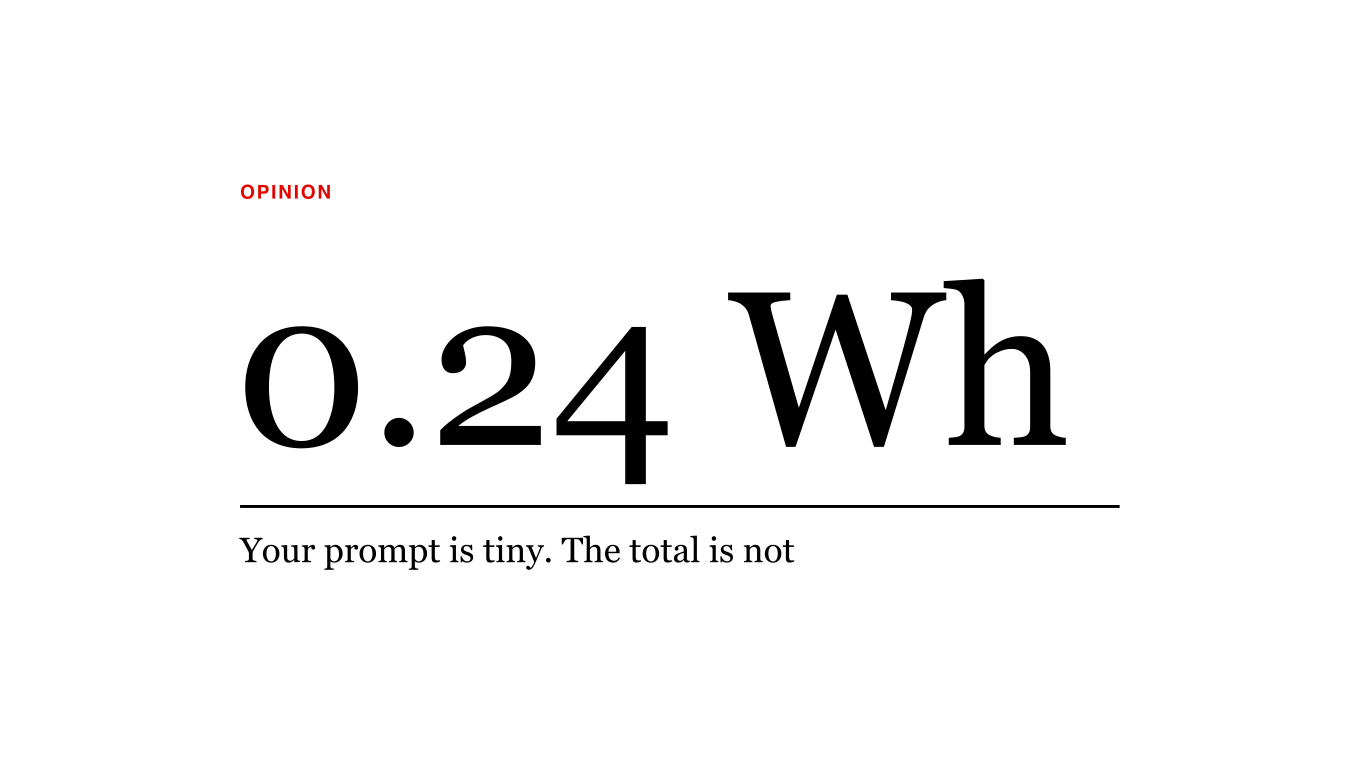
By Google’s estimate, the median text prompt in its Gemini apps uses about 0.24 watt-hours of energy, emits 0.03 grams of CO₂ equivalent and consumes about 0.26 millilitres of water, roughly five drops. Google compares the energy to watching TV for less than nine seconds. It also said the energy per prompt fell 33-fold over one year, thanks to better software and hardware.
Other measurements vary, and image or video generation and long “reasoning” answers use much more. But for an ordinary text question, the honest answer is: your prompt is small. Skipping one does less for the planet than skipping a few minutes of a hot shower.
The number that matters
Here is my problem with stopping there. Tiny numbers multiplied by billions are not tiny. The International Energy Agency estimates that data centres used about 415 terawatt-hours of electricity in 2024, around 1.5% of the world’s electricity, and that this could more than double to around 945 TWh by 2030, with AI as the main driver.
And efficiency gains have a well-known habit of being eaten by growth. When something gets 33 times cheaper, we tend to do a lot more than 33 times as much of it, especially when AI gets built into every search, email and spreadsheet by default.
Where the pressure should go
Individual guilt is the wrong tool. The decisions that matter are made by companies and governments: where data centres are built, what power they run on, whether the grid and the water supply can cope, and whether AI is switched on by default in places nobody asked for it.
My view: use AI when it is useful, without guilt. But ask the companies selling it for the totals, not just the per-prompt numbers, and judge them on whether their total footprint goes down, not just their footprint per question.