By Roman Aglaganov
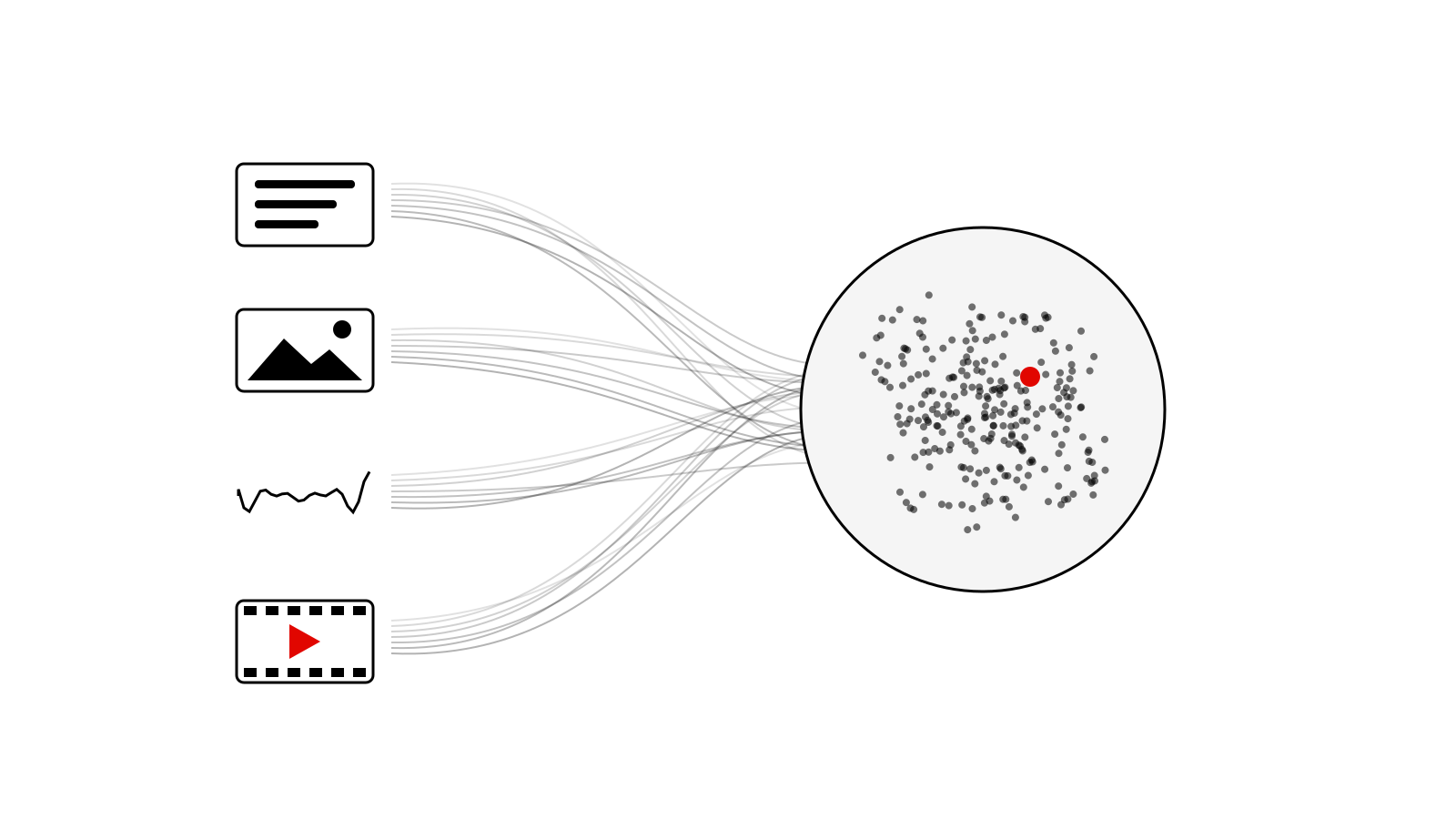
Chatbots get the attention, but a lot of useful AI is done by embedding models. They turn a piece of content into a list of numbers, a vector, so that similar things end up close together. That is how search finds a document that means what you asked, even when it uses different words. On 6 October, Google released EmbeddingGemma 2, which does this for almost any kind of media, on your own device.
What is new
Every format in one space: text, code, images, audio and video all map into the same 768-number space. So a text query can find a video clip, or a voice memo can find a photo.
Small and modular: the full model has 740 million parameters, tiny by today’s standards. Text-only use needs as little as 270 million, with optional vision and audio encoders added when needed. With quantisation, Google says it needs about 191MB of memory for text alone and about 567MB for everything, on a Pixel 11 Pro.
Flexible size: thanks to a technique called Matryoshka representation learning, the vectors can be cut from 768 numbers to 512, 256 or 128, saving up to six times the storage at some cost in quality.
More context: an 8,000-token window, four times the first version, enough for about five and a half minutes of audio or 29 images in one go.
It is released under the permissive Apache 2.0 licence, so developers can use it commercially. The first EmbeddingGemma, a text-only model launched last year, passed 20 million downloads.
Why it matters
Embeddings that run locally mean private search: your photos and recordings never have to leave the phone to be found. They are also the retrieval half of many AI assistants, finding the right notes before a chatbot answers. A good, small, open multimodal model makes that kind of app much easier to build.